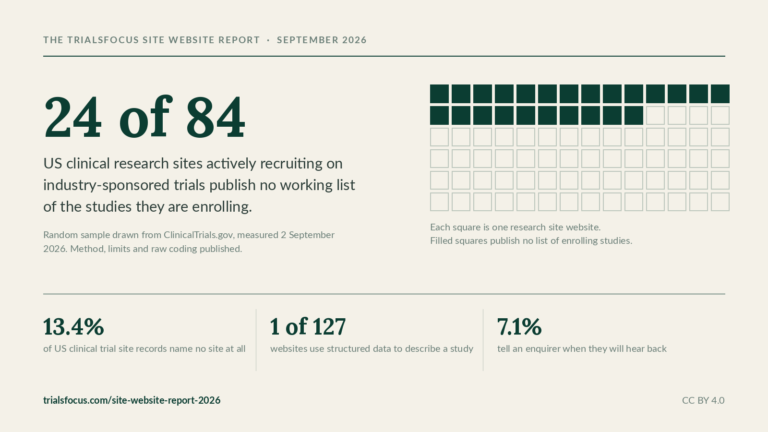
Clinical research has quietly become a web-first industry. Sponsors and CROs now form their first impression of a research site during feasibility, long before anyone schedules a call, and that impression is formed on the site's website. Patients do the same. Before they answer an outreach call or submit a screening form, they search the …

Clinical research has quietly become a web-first industry. Sponsors and CROs now form their first impression of a research site during feasibility, long before anyone schedules a call, and that impression is formed on the site’s website. Patients do the same. Before they answer an outreach call or submit a screening form, they search the facility and read what they find. In oncology, Alzheimer’s, and rare disease, the person doing that reading late at night is often a caregiver, not the patient.
Despite all of this, most websites in clinical research are still built by generalist agencies: teams that can produce a handsome homepage but have never sat through a feasibility questionnaire, never thought about how an IRB reads a recruitment page, and never asked what a sponsor is actually looking for when they open a site’s website. The result is a familiar one across the industry: websites that photograph well and perform nothing.
A small group of agencies does specialize in this space, and the landscape splits into two camps. On one side are recruitment-led vendors, where the website exists to serve an enrollment campaign: built fast, wired to paid traffic, measured in referrals. On the other are design-led studios, where the website is the product itself: the permanent web presence that carries a research organization’s credibility between studies. Neither camp is better. They solve different problems, and most disappointment in this market comes from hiring one camp to do the other camp’s job.
This guide covers five agencies that do real, verifiable work in clinical research. Every one of them has a live, named offering for trial or research websites; general healthcare marketing agencies that list pharma as one vertical among twenty were left out. One disclosure before the list: Trialsfocus is our own studio, so read that entry knowing it was written from the inside. The order is not a ranking. Each entry ends with a “best fit” line, because the right choice depends entirely on who you are and what you need.
At a glance:
- Trial AMPlify: recruitment agency for sponsors, websites as part of enrollment campaigns
- Trialsfocus: boutique studio, websites for US research sites only
- Ladybugz Interactive: UX-driven agency for clinical-stage biotech and pharma
- CMDS: research-heavy UX for pharma, strong on caregivers and localization
- Minerva Research Solutions: compliance-minded landing pages plus paid recruitment traffic
Table of Contents
Toggle1. Trial AMPlify
Trial AMPlify is a patient recruitment agency with more than a decade in clinical trials, and website design is one of the tools in its recruitment toolkit. They build study websites and landing pages as part of larger enrollment campaigns, alongside Google Ads, programmatic advertising, and SEO, and they work with recognizable sponsors and research institutions.
Pros: deep recruitment expertise, real clinical trials focus rather than general healthcare marketing, and websites that are built to convert visitors into referrals because that is the entire point of their model.
Cons: the website is a means to a campaign, not the product. If you are a research site that needs a permanent, credible web presence rather than a study-specific enrollment funnel, you are outside their core use case. Pricing is not published.
Best fit: sponsors and biotechs running active enrollment campaigns who want websites and recruitment handled together.
2. Trialsfocus
Trialsfocus is our studio: a boutique agency focused entirely on clinical trials web design for research sites and small site networks in the US. Everything is measured against the Trialsfocus Benchmark, a published 70-item standard covering how a website reads to two very different visitors: the patient deciding whether to call, and the sponsor or CRO deciding whether the site belongs on a feasibility shortlist.
Pros: single-niche focus, a public standard the work can be checked against, and a dual-audience approach built on one uncomfortable observation: sponsors open a website to disqualify a site, not to admire it. Projects start at five thousand dollars, typically run about two months, and clients talk directly to the people doing the work.
Cons: a deliberately small team, which means limited project slots. The studio only serves research sites and site networks; sponsors who need study recruitment websites at scale, or hospital systems with procurement processes, are outside its scope. No recruitment ad campaigns.
Best fit: owner-operated research sites and small networks that want their website to work as hard in a feasibility review as it does with patients.
3. Ladybugz Interactive
Ladybugz is a Boston-area web agency with a strong healthcare and biotech practice, and clinical trial websites are a defined service within it. They bring a patient-first methodology: discovery workshops, health literacy principles, accessibility, and WordPress builds designed to scale across multiple trials.
Pros: mature UX process, serious about accessibility and plain language, and comfortable with the needs of clinical-stage biotechs managing several studies or rare disease programs.
Cons: clinical trials are one vertical within a broader agency, and their center of gravity is the sponsor side rather than the research site side. Public case studies with recruitment outcomes are thin.
Best fit: clinical-stage biotech and pharma teams that want an established UX-driven agency for trial and corporate websites.
4. CMDS
CMDS is a New Jersey agency that has done thoughtful clinical trial web design work for pharmaceutical clients, including research-heavy projects with stakeholder interviews and persona development. Notably, their process takes caregivers seriously as an audience, which much of this industry still overlooks.
Pros: genuine research-driven UX, multi-persona thinking that includes patients, caregivers, and clinicians, and experience with global rollouts and localization.
Cons: clinical trials are a portfolio category rather than the agency’s identity, publicly documented clinical work is limited, and the orientation is large pharma rather than independent research sites.
Best fit: pharmaceutical teams with international, multi-language trial website needs and internal stakeholders to align.
5. Minerva Research Solutions
Minerva Research Solutions is a patient recruitment company that offers clinical trial web design as a defined service: landing pages and websites built to GCP and IRB requirements, paired with SEO, Google Ads, and conversion tracking to bring participants to them.
Pros: compliance is treated as a design requirement rather than an afterthought, and the website comes wired into paid traffic and analytics from day one, which matters when enrollment timelines are tight.
Cons: like most recruitment-led shops, the website serves the campaign. Public case studies are scarce, it is not always clear whether their default client is a sponsor or a research site, and pricing is not published.
Best fit: teams that want a compliant study website and the paid traffic to fill it, handled by one vendor.
How to actually choose
Ignore the order and ask three questions instead. Who does the agency serve by default, sponsors or research sites, because everything downstream follows from that. Does the website exist to support one study’s enrollment or to carry your whole business, because those are different projects. And can they show you a standard, a process, or work you can inspect, because in clinical research, claims without evidence should make you uneasy professionally.
Your website will not win you a trial. But it can lose you one, and it is worth choosing deliberately who you trust with that.

Ali Demirci
Ali Demirci has been designing and building websites since 2011, with work ranging from a London charity to Panasonic, and now focused almost entirely on clinical research. Trialsfocus was built around a single observation: a research site's website is read by a patient deciding whether to trust you and a sponsor deciding whether to shortlist you, and most sites are written for neither. He also publishes the Trialsfocus Benchmark, a 70 point public standard for research site websites.