Sponsors increasingly expect research sites to contribute their own enrollment. There is a published standard for what a research site website should contain, and we wrote it. What did not exist was a measurement of how many sites meet it. So in September 2026 we measured two things: what the trial registry tells a patient …

Sponsors increasingly expect research sites to contribute their own enrollment. There is a published standard for what a research site website should contain, and we wrote it. What did not exist was a measurement of how many sites meet it.
So in September 2026 we measured two things: what the trial registry tells a patient about where studies are running, and what the sites’ own websites do when a patient arrives.
This page is the full report. Every figure carries its denominator and its date, the method is documented well enough to repeat, the limits are stated, and the raw coding is available. No individual site is named, and none will be.
Cite as: Trialsfocus Site Website Report 2026, V1, retrieved [date]. Published under CC BY 4.0.
Table of Contents
ToggleIn one screen
| 13.4% | of US site records on industry-sponsored recruiting trials carry no identifiable site name |
| 9.2% | of studies recruiting in the US are anonymised at every single US location |
| 7.9% | of research organisations drawn at random had no working website at all |
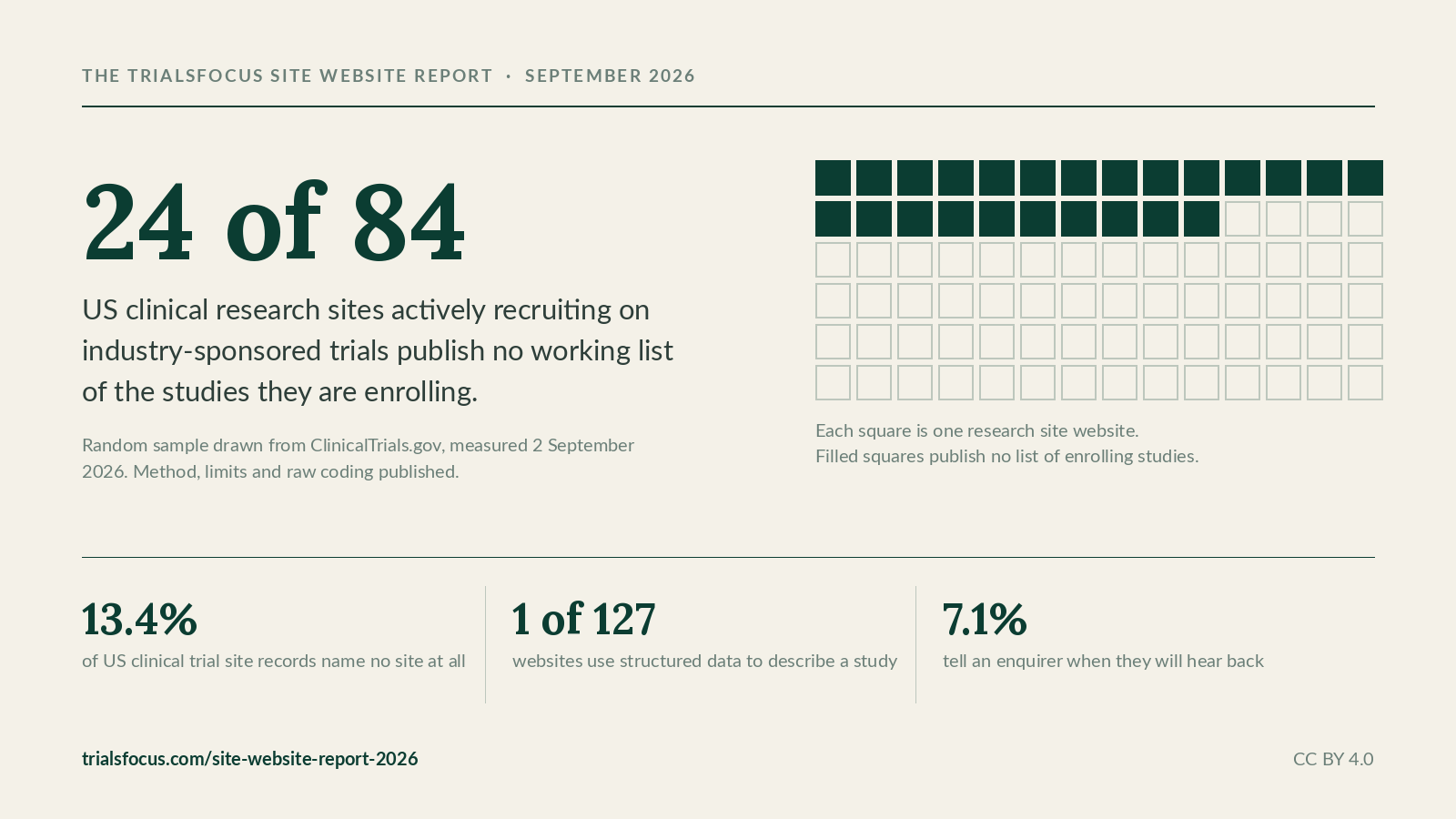
| 28.6% | of research site websites publish no working list of the studies they are enrolling |
| 45.2% | publish eligibility criteria for any individual study; median reading grade 9.4 |
| 30.1% | carry a third-party advertising pixel; 22.9% present any consent mechanism |
| 7.1% | tell an enquirer when to expect a response |
| 1 of 127 | websites use structured data to describe a clinical study |
Registry figures from 4,917 studies and 60,032 US site records. Website figures from 127 websites across three cohorts, 84 of them in the primary cohort. Measured 2 September 2026.
Part 1: What the registry tells a patient
The common assumption is that ClinicalTrials.gov is how patients find studies. It is not built to be, and the data shows what that costs.
On 2 September 2026 we retrieved every interventional study with an industry lead sponsor recruiting at a US location.
| Measure | Value |
|---|---|
| Studies retrieved | 4,917 |
| Studies with at least one recruiting US location | 4,788 |
| US recruiting site records | 60,032 |
| Distinct US facility names | 26,874 |
| Median US sites per study | 5 |
| Site records with no identifiable site name | 8,025 (13.4%) |
| Studies anonymised at every US location | 440 (9.2%) |
A record counted as anonymised reads “Research Site”, “Clinical Study Site”, “GSK Investigational Site”, “Local Institution” or “Site 0123”. A city, a state, and nothing else.
For those 440 studies, a patient can learn that a trial exists somewhere in their state and cannot learn who is running it, what the site is called, or how to reach anyone. There is no number to call because there is no name to call.
This is not a criticism of the registry, which was built as a compliance record rather than a directory, and anonymisation is a sponsor decision rather than a site one. It is the reason the next part of this report matters: for roughly one study in ten, the site’s own website is the only route a patient has.
Part 2: The websites
From that frame we drew 127 records at random, using a seeded shuffle so the draw can be repeated exactly.
Ten of those 127 (7.9 percent) had no working website at all. A domain resting on a for-sale parking page, an “under construction” placeholder, a homepage serving the web server’s default welcome screen, or nothing beyond a third-party directory listing. Two further records could not be identified as existing organisations at all.
Resolving the rest to websites, removing academic and hospital-owned organisations, CROs and duplicates, and collapsing multi-location organisations to a single website produced the cohorts below. Two notes on composition, because they matter for how much weight the findings carry. Eight of the 84 websites in the primary cohort did not come from the random draw; they were added from a supplied list of US research sites and are identified in the data file. And one of the 84 serves only its web server’s default page; it is kept in the denominator as a website that does not work, rather than quietly dropped.
Seven of the 127 websites scanned did not load for our scanner at all, one of which returned a 403 and then loaded normally on a second attempt from a different profile.
Everything below reports the primary cohort: 84 dedicated research sites and site networks.
Can the study be found?
| Measure | Cohort A1 (n=84) |
|---|---|
| Publishes a working list of enrolling studies | 56 (66.7%) |
| Publishes no working list | 24 (28.6%) |
| Publishes only condition-level pages, no study list | 2 |
| Not assessable (blocked our scanner, or serves no page) | 2 |
| Of the 56 working lists, present only in JavaScript | 7 (12.5%) |
| Studies have their own URL | 37 (44.0%) |
| Links or cites a ClinicalTrials.gov NCT identifier | 4 (4.8%) |
| Uses MedicalTrial or MedicalStudy structured data | 1 (1.2%) |
The 24 sites with no working list are not sites with a thin list. The failure modes repeat across the sample: a “Current Studies” page containing only a contact form; a study widget stuck on “Loading”; a therapeutic-area list with nothing behind it; “Learn More” links that are dead anchors; a page holding two PDF viewers; and one site still carrying its hosting provider’s unedited template copy where the studies should be.
Fifty-six percent of sites do not give an individual study its own address. That means nothing for a search engine to rank, nothing for an answer engine to cite, and nothing for a patient to send to their doctor.
The smallest number in the report is the most striking. Across all 127 websites scanned, one describes a study in structured data, and nine link a ClinicalTrials.gov NCT identifier, four of them in the primary cohort. Markup on these sites is otherwise generic CMS output: WebPage, Organization, BreadcrumbList. Twenty-three sites in the primary cohort emit no JSON-LD at all. The schema.org vocabulary for clinical trials has existed for years and is, in this sample, effectively unused.
Can it be understood?
| Measure | Cohort A1 |
|---|---|
| Publishes per-study eligibility text | 38 of 84 (45.2%) |
| Texts scored | 38 |
| Median Flesch-Kincaid grade | 9.4 |
| Mean | 9.7 |
| Range | 2.3 to 21.8 |
| Above grade 8 | 24 of 38 (63%) |
| Above grade 12 | 9 of 38 (24%) |
Published research on clinical trial recruitment materials finds a mean readability of grade 11.7, and separately that eligibility criteria require a college reading level. Against that, a median of 9.4 looks like an improvement.
It is not, because of the row above it. For more than half of these sites the eligibility text does not exist at all. A patient cannot self-select. They can only phone and ask, which is exactly the coordinator time the website was supposed to protect.
Where the text does exist, the range is the useful finding: 2.3 to 21.8, on the same kind of page, for the same kind of study. Plain writing is achievable inside this sample. Most sites simply paste the protocol.
Can the site be trusted?
Measured on the served homepage, clean browser profile, no interaction, no consent given. n=83; one site in the cohort serves no page.
| Measure | Cohort A1 |
|---|---|
| Third-party advertising or social pixel present | 25 (30.1%) |
| Meta pixel specifically | 21 (25.3%) |
| Session-recording tool (Clarity, Hotjar) | 8 (9.6%) |
| Any advertising, social or session-recording tool | 28 (33.7%) |
| Analytics (GTM or GA4) | 55 (66.3%) |
| Any consent mechanism present | 19 (22.9%) |
| Advertising pixel and no consent mechanism | 15 (18.1%) |
| No reachable privacy policy | 30 of 84 (35.7%) |
| Served over HTTP only | 1 |
Where a consent mechanism exists it frequently gates nothing. The scan observed Meta, Bing, HubSpot advertising and Microsoft Clarity pixels firing while a cookie banner sat unanswered on screen, and one site loaded a consent platform that never rendered a banner at all. Only a handful gate anything: in the primary cohort, four sites were observed actually holding their tags until a choice was made.
Nine sites carry an advertising pixel and ask for health information on a form. Three of those nine also have no privacy policy anywhere. One site is served over plain HTTP, with no privacy policy, and collects a 51-field questionnaire including date of birth, ethnicity and medical conditions.
For context: analysis of 3,747 US hospital websites found 98.6 percent transferring data to third parties from the homepage. Thirty percent is far below that, and that is not the comfort it appears to be. Hospitals are large institutions with compliance functions and litigated legal exposure. A quarter of independent research sites running a Meta pixel with no consent layer, on pages built to collect health information from strangers, is the same category of risk carried by organisations far less equipped to notice it.
Can contact be made?
| Measure | Cohort A1 |
|---|---|
| No contact or pre-screening form anywhere | 9 (10.7%) |
| Forms with at least one unlabelled field | 28 of 64 measurable (43.8%) |
| Median field count | 8 |
| Largest form | 268 fields |
| No visible phone number | 20 (23.8%) |
| States a response time | 6 (7.1%) |
An unlabelled field is the difference between a form a screen reader can complete and one it cannot. The largest form in the sample presents a checklist of more than 250 conditions.
The last row is the one that would change an enrollment number. Ninety-three percent of these sites ask a stranger for health information and say nothing about what happens next. Central recruitment vendors work to service-level agreements. A site’s own website usually has nothing, and no regulation requires one.
Part 3: Does being bigger help?
Alongside the random sample we scanned a deliberately chosen cohort of 27 well-known US site networks and SMOs: organisations with marketing departments, recruitment budgets and industry visibility. They were expected to score better. A third cohort of 16 medical practices that also run research is reported separately, because their websites serve a clinical practice first.
| Measure | A1 random sites (n=84) | A2 practices (n=16) | B established (n=27) |
|---|---|---|---|
| No working studies list | 28.6% | 5 of 16 | 9 of 27 |
| Studies have own URL | 44.0% | 1 of 16 | 8 of 27 |
| MedicalTrial structured data | 1 of 84 | 0 of 16 | 0 of 27 |
| Links an NCT identifier | 4.8% | 4 of 16 | 1 of 27 |
| Per-study eligibility text | 45.2% | 2 of 16 | 7 of 27 |
| Median FK grade | 9.4 | 11.6 (n=2) | 8.6 (n=7) |
| No privacy policy | 35.7% | 5 of 16 | 3 of 27 |
| Advertising, social or session-recording tool present | 33.7% | 4 of 16 | 9 of 27 |
| States a response time | 7.1% | 0 of 16 | 1 of 27 |
Two results stand out.
Structured data is absent everywhere. Scale, funding and industry standing change nothing about it. Across 127 websites, one.
The better-resourced cohort tracks more, not less. The heaviest tracking in the entire study sits in cohort B, including one site firing five advertising pixels before any consent. Tracking is heaviest precisely where recruitment marketing is most professionalised, which is to say precisely where the volume of health-information traffic is largest.
The practices in cohort A2 fail differently. They are the most likely to link to ClinicalTrials.gov and the least likely to have a studies page or a form of their own, because the website is built for clinical care and research is a subsection of it.
What this looks like from a sponsor’s side
Feasibility is largely a desk review. Someone opens the website before a questionnaire is sent. On the numbers above, that reviewer has a better than one in four chance of landing on a site that does not say what it is enrolling, and a better than one in three chance of finding no privacy policy on an organisation that collects health information through a web form.
Neither of those is a judgement about the quality of the research. That is the problem. The website is being read as evidence about the site, and for a large share of sites it is arguing against them.
What to do about it, in order
If you run a research site, the order matters more than the list. These are ranked by what the data says is both most broken and most fixable.
- Publish what you are enrolling, in HTML. Not a widget, not a PDF, not a form. A page per study with a plain-language description, basic eligibility and a location. This alone moves you past 28.6 percent of the sector.
- Give each study its own URL, and keep the URL when the study closes. Redirect it to the condition or location page rather than serving a 404. Fifty-six percent of sites have no address to keep.
- Check what fires before consent. Open your homepage in a private window with developer tools on the network tab and look at what loads before you click anything. If a Meta pixel is on a page where somebody types a diagnosis, that is the first thing to fix.
- Write the eligibility criteria for a person. Target grade 8. The sample contains sites at grade 2.3, so it is achievable.
- Tell people when you will call. One sentence next to the form, and a named owner for the inbox. Seven percent of sites do this.
- Add study markup. MedicalTrial with the NCT identifier in the code property. One site in 127 does this, which makes it the cheapest available differentiator in the sector.
Items 1, 2 and 6 are also the items that determine whether an AI answer engine can describe your studies at all. That is not a separate project from patient recruitment. It is the same project.
Method
Documented so that anyone can check this, disagree with it, or repeat it.
Registry analysis
Source: ClinicalTrials.gov API v2, no key required. Retrieved 2 September 2026.
Filter: overall status RECRUITING, lead sponsor class INDUSTRY, at least one United States location. From each study we kept only location records whose country is the United States and whose own recruitment status is RECRUITING. Result: 4,917 studies, 60,032 US site records, 26,874 distinct facility names.
A facility name was counted as anonymised if it matched, case-insensitively, any of: Research Site, Clinical Research Site, Clinical Study Site, Clinical Trial Site, Investigational Site, Investigative Site (including sponsor-prefixed forms such as “GSK Investigational Site”), Study Site, Study Center, Research Center or Research Facility standing alone, Clinical Site, Investigator Site, Trial Site, Research Unit, Local Institution, and Site followed by a number.
The rule is deliberately conservative. A name that identifies a real organisation is never counted as anonymous, so 13.4 percent is a floor rather than a ceiling.
Sample frame
From the 26,874 distinct names we removed anonymised placeholders and names carrying academic, hospital or health-system markers, and kept names matching dedicated-research-organisation patterns. Eligible frame: 3,310 facility names.
From that frame, 130 records were drawn using a seeded shuffle (linear congruential generator, seed 20260902) so the draw is exactly reproducible, then deduplicated on cleaned name to 127. Sponsor-added suffixes such as /ID# 261476, – Site Number : 8400037 and (Site 0123) were stripped before deduplication.
Each record was resolved to an official website by search, reclassified by what the organisation actually is, and multi-location organisations were collapsed to a single website. The unit of analysis is a website, not a facility.
Cohort B was drawn separately and purposively from SCRS visibility, known US site networks and SMOs, and industry press. It is not a probability sample and is expected to be better than average. It is never pooled with cohort A.
| Cohort | Description | Websites |
|---|---|---|
| A1 | Dedicated research sites and site networks. Primary cohort: 76 from the seeded random draw plus 8 added from a supplied list. | 84 |
| A2 | Medical practices with a research arm. | 16 |
| B | Established site organisations, purposive. | 27 |
Website scan
Each site was loaded in a real browser with a clean profile at 1280×800, with no prior consent state. Third-party requests were captured from first paint before any interaction, and tracker presence was additionally verified against the served HTML. The studies page was located by following homepage navigation, then fetched a second time without JavaScript to compare. One study detail page was opened per site for eligibility text, scored with Flesch-Kincaid on extracted body text with navigation and boilerplate removed. Forms were inventoried for field count, programmatic labelling, and whether they solicit health information.
No form was ever submitted. Sending fabricated enquiries to real research sites would consume coordinator time and contaminate recruitment funnels, so form functionality is untested by design. One pass per site, rate-limited, no repeat crawling, only publicly reachable pages, nothing behind a login, nothing downloaded.
A correction we had to make mid-study
Sites 1 to 95 were originally coded from tracker requests that actually fired in the scanning browser. From site 96 the scan also checked the served HTML, and found that the scanning browser profile blocks a share of tracker requests: on one batch of ten sites, Google Tag Manager was present in the HTML of seven and fired in none.
The entire primary cohort was therefore re-scanned at markup level, and all privacy figures in this report come from that second pass. The correction roughly doubled the number. It is documented here rather than quietly fixed, because a reader is entitled to know that the first method was wrong.
Independent re-coding
Ten of the 84 primary-cohort sites were re-coded blind by a second scanner that had not seen the original results.
- Advertising pixel present: 10 of 10 agreement. Every site matched, including the exact pixel list on the most heavily tracked site in the subset. This measure is mechanical and stable.
- Working studies list: 8 of 10 agreement. Two disagreements in opposite directions, both corrected in the dataset. Because they cancel, the 24 of 84 figure is unchanged.
So: the pixel and structured-data measures are mechanical and reliable. The studies-list measure carries roughly 80 percent inter-coder agreement and 28.6 percent should be read as approximately, not exactly. A full second coding pass would tighten it, and is planned.
Limits
- The primary cohort is 84 websites, not a census. Seventy-six of them came from a seeded random draw, which is what makes a sample this size defensible; the other eight were added from a supplied list and are marked in the data. It is still 84.
- A single day’s snapshot. Sites change, and a site measured on a bad day is recorded as it was on that day.
- Most measures were coded once. See the re-coding section above for what that costs.
- Flesch-Kincaid is a proxy for comprehension, not comprehension.
- Third-party requests were captured from one geography, one browser, one visit, with no ad-blocking. Markup presence proves a tag is deployed and not gated; it does not prove it fires for every visitor.
- One website returned 403 to the first scanner and loaded normally for the second. Server-side bot filtering means “did not load” is not always “is not there”.
- Cohort A1 represents named sites on industry-sponsored studies. It does not represent academic sites, federally funded studies, sites that recruit only through their sponsor, or the 13.4 percent of records that carry no name at all.
Data
The raw coding is available on request while we prepare a public download: one row per website, with the third-party request list, detected structured data, eligibility text scores and form inventory. Site names are removed. Write to info@trialsfocus.com.
Corrections
If a figure here is wrong, tell us. Corrections are published on this page with the date they were made. This is version 1, published 2 September 2026. Registry figures are re-run quarterly and this page carries the date of the most recent run.
Conflict of interest
Trialsfocus builds websites for clinical research sites. That is a real interest in these findings, and the reason the method, the seed, the correction and the raw data are all published: so that the results can be checked rather than taken on trust. No site in the sample is a current or former client, no site is named, and no site is identified as failing any measure.
Related
- The Trialsfocus Benchmark — the 70-item standard this report measures against
- Digital Patient Experience in Clinical Research — why these five things are the ones worth measuring
If you would like to know where your own website stands against the benchmark, write to us. We take on a limited number of reviews each month.

Ali Demirci
Ali Demirci has been designing and building websites since 2011, with work ranging from a London charity to Panasonic, and now focused almost entirely on clinical research. Trialsfocus was built around a single observation: a research site's website is read by a patient deciding whether to trust you and a sponsor deciding whether to shortlist you, and most sites are written for neither. He also publishes the Trialsfocus Benchmark, a 70 point public standard for research site websites.