Planning a biotech or life science website? The key decisions to make before you brief an agency, from audiences and claims to your clinical trials section.


Most life science website projects start with a design question. What should it look like? Which sites do we admire? Those are fair questions, but they come too early.
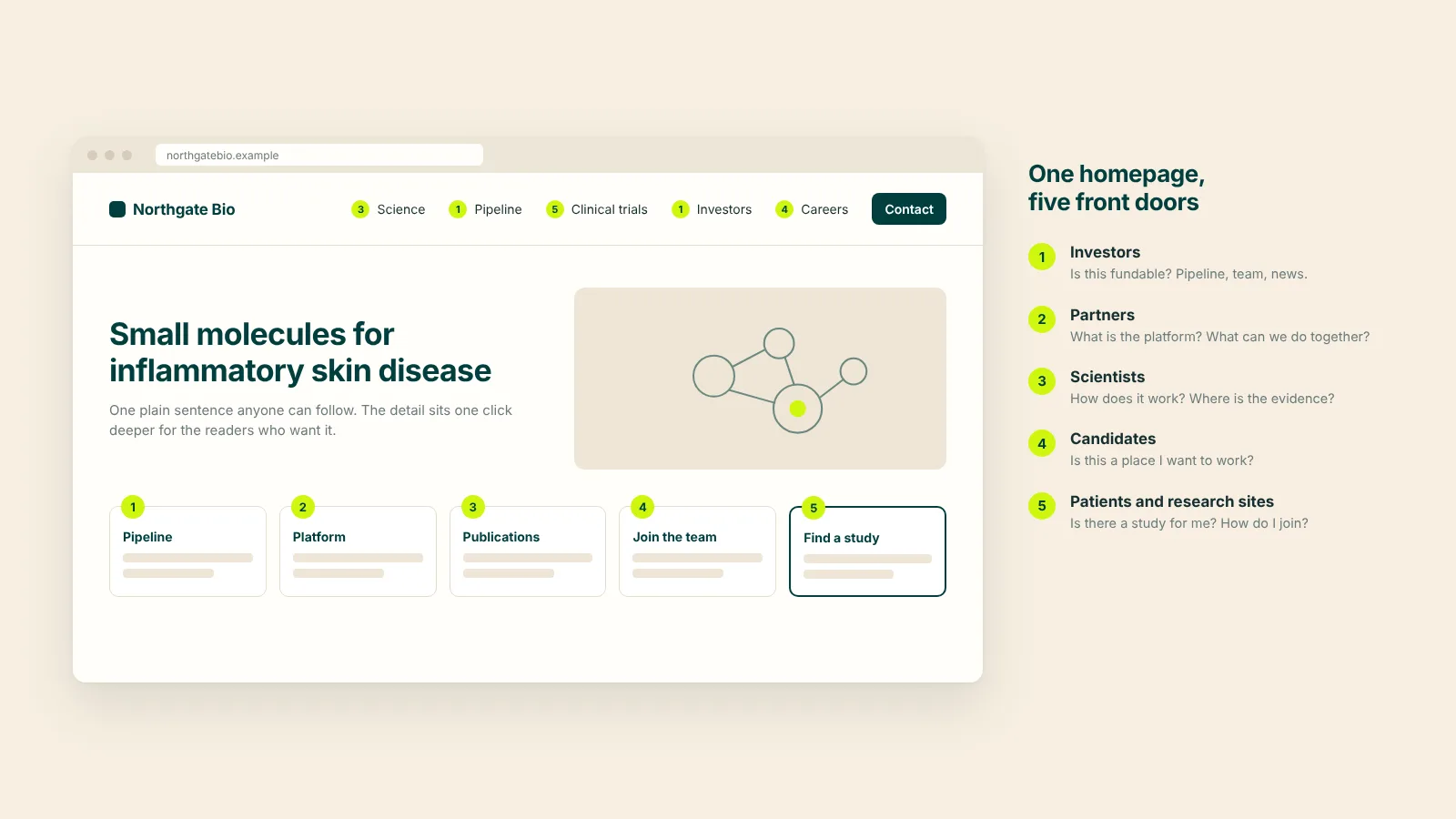
A life science website has to work for people who want very different things. An investor wants the thesis in a minute. A scientist wants the mechanism and the data. A patient wants to know if there is a study near them. If you have not decided who comes first and what each person needs, the design will guess for you.
We build websites for US clinical research sites. So we often see a sponsor’s website from the other side, where a study coordinator or a patient tries to work out how to join a trial. This guide covers the decisions worth making before you brief an agency, with extra attention to the part most guides skip.
Short answer: Before building a life science website, decide who it serves first: investors, partners, scientists, candidates or patients. Then settle what your company stage needs, what you can legally say about products still in development, how trials will be shown if you run them, who will keep the content current, and how you will handle speed, accessibility and any health data.
What we have learned from building clinical research websites
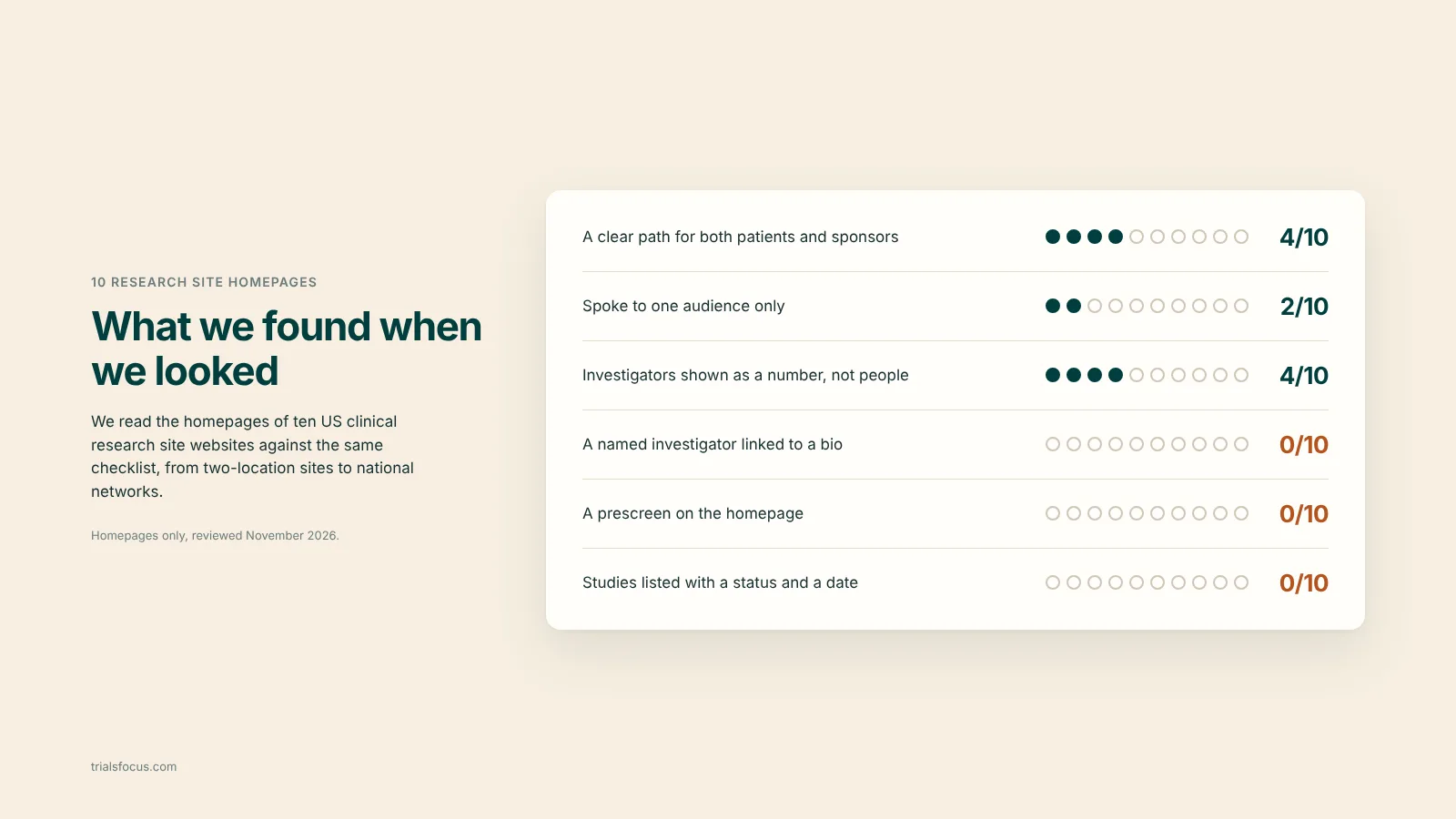
Most of what goes wrong on a life science website is a trust problem, and we see the same ones again and again on clinical research sites. To check our own impressions, we read the homepages of ten US clinical research site websites in November 2026. We used the same checklist for each, from small two-location sites to national networks. We used AI tools to help read the pages. Three lessons stood out.
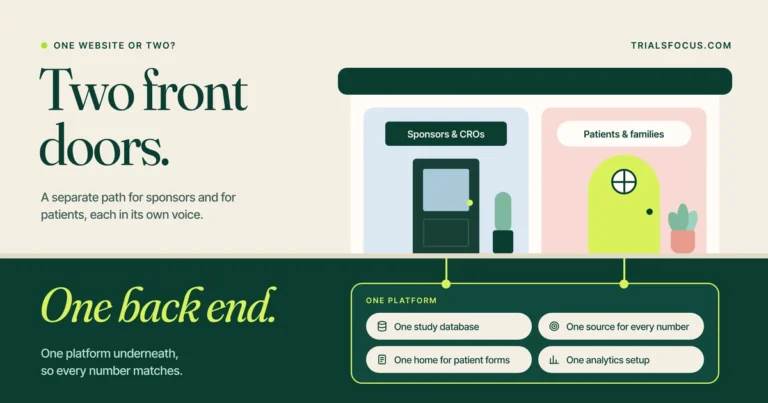
1. Many sites do not know who they are talking to. A research site serves patients and sponsors at the same time. Only four of the ten homepages gave each group a clear path of its own. Two spoke to one audience only. Others tried to fix this by splitting into separate sites or brands. Then they lost the link between them, so a patient could not be sure they were still with the same organization. Two audiences can share one website. What breaks trust is when they cannot find each other.
2. The doctors are missing. In healthcare, trust starts with a person. None of the ten homepages linked a named investigator to a bio with credentials. Four replaced people with a number, such as “200+ investigators”. A number tells a sponsor you are big. A name, a photo and a short background tell a patient who will actually care for them.
3. Stock photos quietly undo the work. On one homepage, the image file names still came straight from a stock photo library. The homepages that felt most credible showed real staff, a real building or a real community event. An imperfect photo of your own clinic does more for trust than a perfect photo of someone else’s.
Two more patterns: none of the ten offered a prescreen on the homepage, and none listed individual studies with a status and a date. These lessons come from research sites, but they apply to any life science website. Name your people, show your real place, and keep your patient and partner paths connected.
Who will visit your life science website, and what does each person need?
A life science website usually serves five groups, and each one judges it by a different question. Write those questions down before any wireframe. They decide your navigation, your homepage order and which pages get built first.
| Visitor | The question they arrive with | Where they look first |
|---|---|---|
| Investor or board member | Is this science fundable, and is this team credible? | Homepage summary, pipeline, leadership, news |
| Partner or licensing lead | What is the platform, and what can we do together? | Platform or technology page, publications, contact |
| Scientist or clinician | How does it work, and where is the evidence? | Science page, publications, posters, conference talks |
| Job candidate | Is this a place I want to work? | Careers, team, culture, location |
| Patient or research site | Is there a study for me, and how do I join? | Clinical trials page, study locations, contact |
The common mistake is writing every page for scientists, because scientists write the first draft. A better pattern is layered content. Each page opens with one or two plain sentences anyone can follow, then goes deeper for the reader who wants the detail. For example, a science page can open with “We are developing a once-daily pill that calms the immune signal behind plaque psoriasis” and only then move to the target, the mechanism and the data.
What stage is your company in?
Your stage decides how much website you need right now. A company in stealth needs a credible holding page. A company with a lead asset in Phase 2 needs a full site with a pipeline and a trials section. Building for the stage you are in, with room to grow, saves a second rebuild a year later.
| Stage | What the site has to do | Pages that usually matter most |
|---|---|---|
| Stealth or seed | Look real to investors and early hires without saying too much | Home, short team page, contact |
| Preclinical | Explain the platform and the scientific basis | Science or platform, team and advisors, publications, careers |
| Clinical | Show progress and help people find your studies | Pipeline, clinical trials, news, investors |
| Commercial | Support approved products and healthcare professionals | Product pages, safety information, HCP section, investor relations |
Plan the structure for the next stage, even if you only fill the current one. Adding a clinical trials section later is easy when the navigation already has a place for it.
What can you say about a product that is still in development?
You can describe what you are studying, but you cannot promote an investigational product or present it as safe or effective for the use being studied. FDA rules say this directly for investigational drugs (21 CFR 312.7) and for investigational devices (21 CFR 812.7). This is a writing problem as much as a legal one, because website copy tends to drift toward promise.
In practice, this shapes a few things on the site:
- Verbs. “Is being studied for” and “designed to” are safer than “treats”, “cures” or “works”.
- Pipeline labels. Show the phase and the indication. Avoid words like “breakthrough” next to an asset that has not been approved.
- Trial pages. A listing with only basic trial details does not need IRB review; added descriptive or promotional text is where IRB review comes in. Keep trial pages consistent with what was approved.
- Review step. Put a regulatory or legal review into the project timeline, not after launch.
This is not legal advice. Your regulatory team or counsel should set the rules for your specific products. The website plan should simply leave time for them to do it.
Do you run clinical trials? Then plan the trials section early
If you sponsor clinical trials, your website will be visited by patients and by the research sites running your studies. Most biotech websites treat the trials page as a short list at the bottom of the pipeline. From the research site side, that list can be where a patient’s interest goes cold.
Look at a sponsor website from the research site’s point of view and a few gaps are easy to spot:
- The study is named by its internal code, which a patient cannot search for.
- The page says “enrolling” for a study that closed months ago.
- There is no link to the ClinicalTrials.gov record, so a coordinator cannot confirm it is the same study.
- There is no way for a patient to find the nearest site, so they leave.
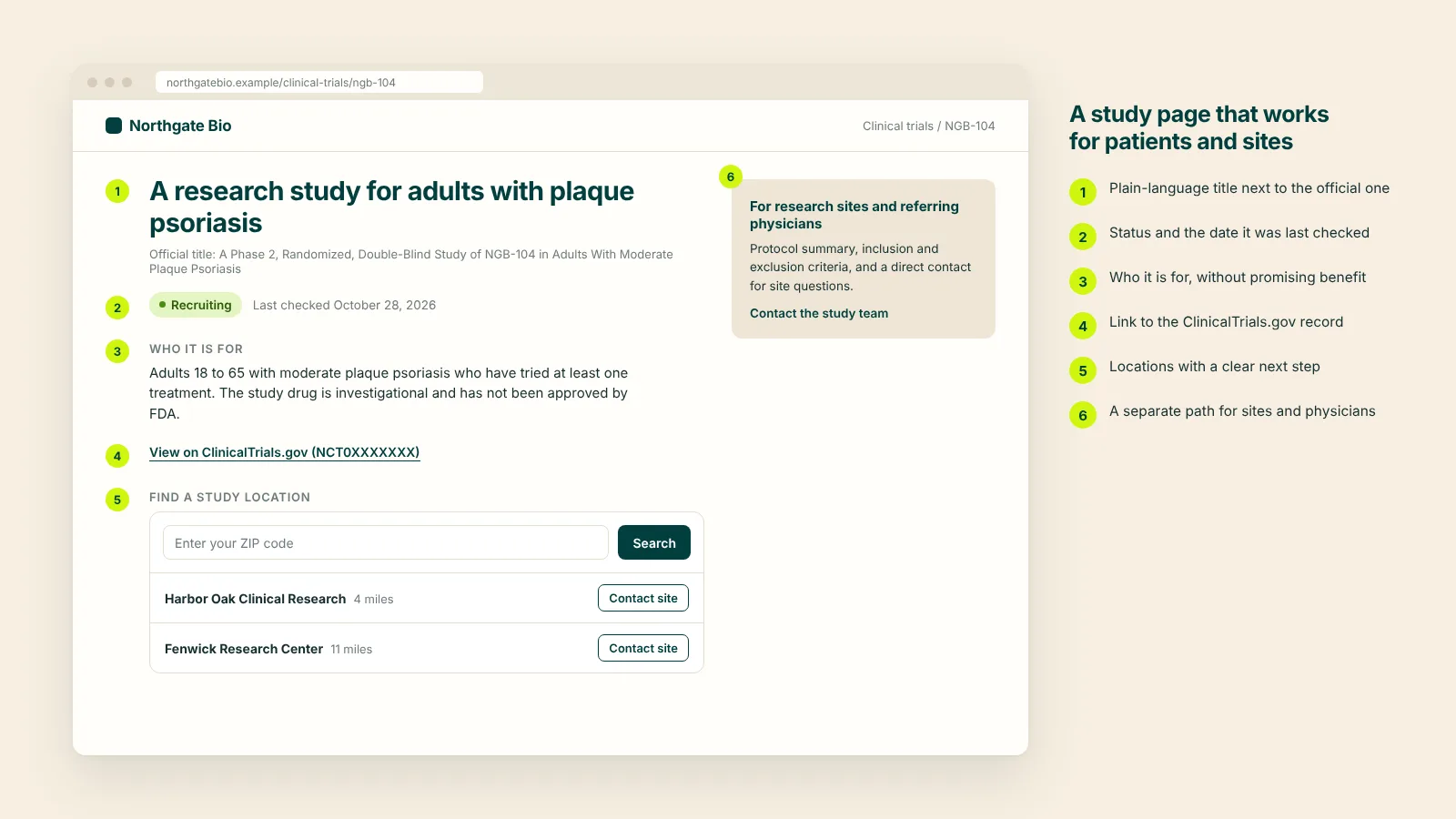
A trials section that works for both patients and sites usually has:
- One page per active study, with a plain-language title next to the official one.
- Status and a date it was last checked, so readers know the information is current.
- Who it is for in two or three sentences, without promising benefit.
- A link to the ClinicalTrials.gov record using its NCT number.
- Locations, either listed or through a location finder, with a clear next step: contact the site or complete a short prescreen.
- A contact for sites and referring physicians, separate from the patient path.
FDA says a listing limited to basic trial information (title, purpose, protocol summary, basic eligibility, locations and how to contact the site) does not need IRB review. When a page adds more description, IRB review helps make sure it does not promise or imply a cure. FDA explains the line in its information sheet on recruiting study subjects. Plan who approves these pages before you write them.
This section is also where your website connects to the sites doing the work. If you want to see what the other side looks like, our article on what a patient website taught us about research sites walks through it.
Who will keep the pipeline, trials and news current?
A life science website goes out of date faster than most, because the company itself changes fast. A phase moves, a study closes, a new hire joins the leadership team. If updating any of that requires a developer, it will not happen on time.
Decide three things before the build:
- An owner for each content type. Pipeline, trials, news, publications and team each need one named person.
- A review rhythm. For example, trial status checked monthly and the pipeline checked after every board meeting.
- An editing setup that fits the owner. The CMS should let a communications lead change a phase or close a study without touching the layout.
Outdated pages cost trust quietly. An investor who sees last year’s phase on the pipeline will wonder what else is out of date.
Will your website collect health information?
If any form on your site asks about a condition, a diagnosis or study eligibility, treat that data with care from the start. Whether HIPAA applies depends on who you are and how the data flows, so it is a question for counsel, not for the web agency. The website plan should still answer a few practical questions early:
- Which forms collect health details? A prescreen form is very different from a general contact form.
- Where does that data go? Email inboxes are a poor home for health information. A secure form tool or a direct handoff to the research site is usually better.
- Which tracking tools run on those pages? Analytics and ad pixels can pick up page visits and form events. HHS has published guidance on online tracking technologies for HIPAA-regulated organizations. In June 2024 a federal court vacated the part about tracking on public pages that need no login. The guidance on logged-in pages, such as patient portals, still stands, and the risk has not gone away.
The simplest approach is to keep marketing pixels off any page that collects health information, and to decide this before launch rather than after.
How fast and accessible will the site be?
Speed and accessibility are easier to build in than to fix later. Life science sites often carry heavy hero videos, 3D molecule animations and large PDFs. Each one can slow the first page down, especially on a phone.
A few decisions help:
- Set a speed budget for the homepage and agree on it with the agency before design starts.
- Use motion with a purpose. One clear animation that explains a mechanism beats a background video that explains nothing.
- Turn key PDFs into pages. A poster or white paper can stay as a download, but its summary should be readable on the page.
- Build to an accessibility standard. The Web Content Accessibility Guidelines (WCAG 2.2) are the common reference. US health rules point to WCAG 2.1 Level AA: HHS requires it from organizations that receive HHS funding, with deadlines now in 2027 and 2028. Building to 2.2 AA also covers 2.1 AA. Patients in trials may have vision, motor or cognitive conditions, so this matters for your audience, not just for a checklist. Our accessibility page explains what a WCAG review covers.
What should you prepare before talking to an agency?
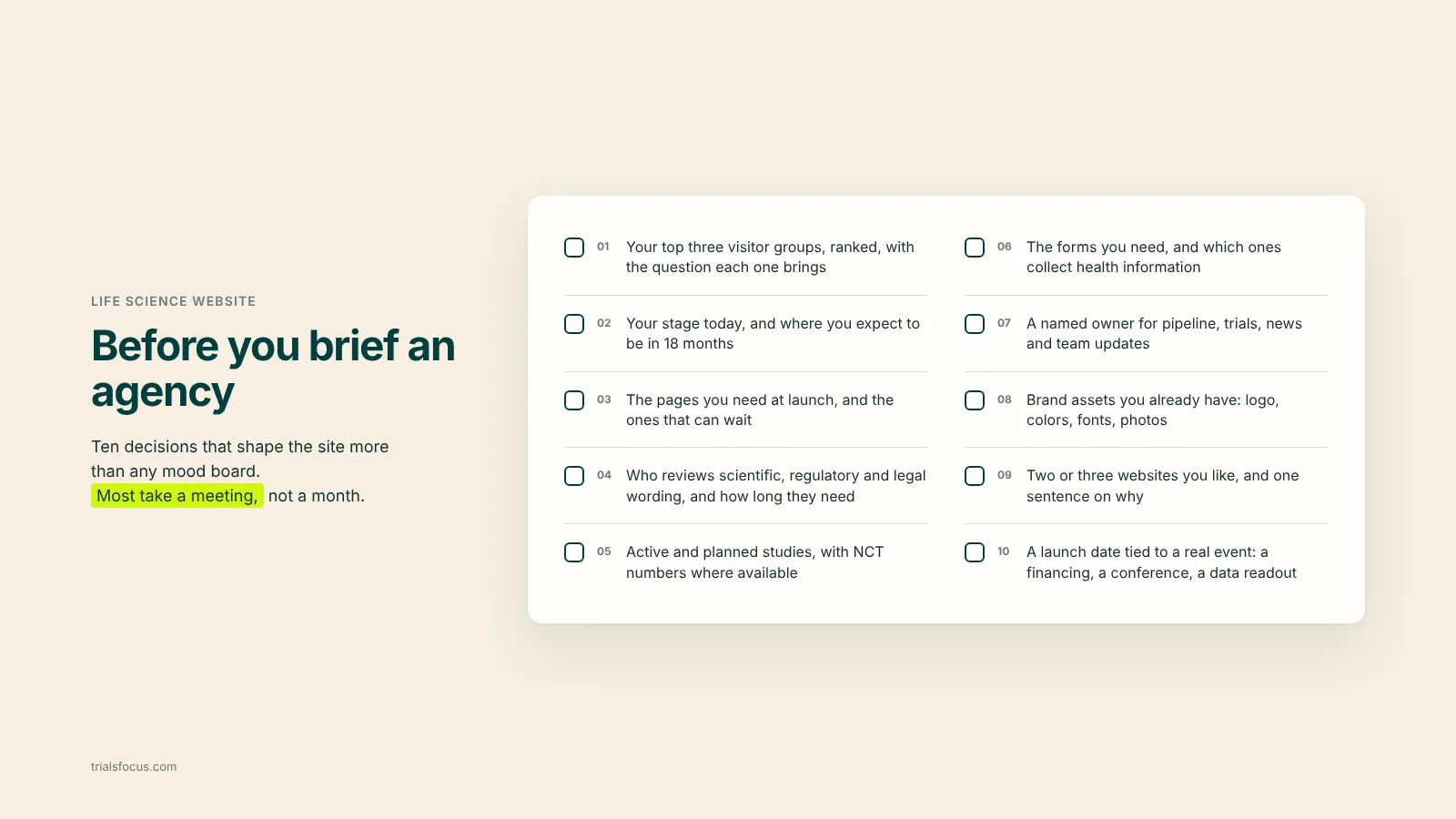
The best agency conversations start with a short brief, not a mood board. Use this checklist to prepare one. Most items take a meeting, not a month.
- The top three visitor groups, ranked, with the one question each arrives with
- Your company stage today and where you expect to be in 18 months
- The pages you need at launch and the ones that can wait
- Who reviews scientific, regulatory and legal wording, and how long they need
- A list of active and planned studies, with NCT numbers where available
- The forms you need and which ones collect health information
- A named owner for pipeline, trials, news and team updates
- Brand assets you already have: logo, colors, fonts, photography
- Two or three websites you like, and one sentence on why for each
- A target launch date tied to a real event, such as a financing, a conference or a data readout
Common mistakes
- Writing only for scientists. Investors and patients leave when the first paragraph needs a PhD.
- Treating trials as an afterthought. A one-line list with internal study codes does not help a patient or a coordinator.
- Promising outcomes. Copy that says a product in development “works” creates regulatory risk.
- No content owner. The site looks right at launch and wrong six months later.
- Pixels on prescreen pages. Tracking tools on forms that ask about health conditions create privacy risk.
- Designing before deciding. Picking a look before agreeing on audiences and pages usually means redesigning later.
Frequently asked questions
What pages does a biotech website need?
Most biotech websites need a homepage, a science or platform page, a team page, news and a contact page. Clinical-stage companies usually add a pipeline page and a clinical trials section. Public companies add investor relations. Start with what your current stage needs and leave room in the navigation for the rest.
Should a preclinical company have a pipeline page?
Yes, if you have named programs and are ready to share them. Keep it simple: program, target or indication, and stage. Avoid language that suggests the product is proven, and update it whenever a program moves.
Do biotech websites need to be HIPAA compliant?
It depends on your organization and how health data moves through the site, so ask your counsel. A website itself is not “HIPAA compliant”. What matters is how forms, storage and third-party tools handle any health information. Keeping tracking pixels off pages that collect health details is a sensible default.
How long does it take to build a life science website?
Timelines vary with scope, content readiness and review cycles. Regulatory and scientific review often takes longer than design. Having your content owners and reviewers named before the project starts is the single best way to keep it on schedule.
Should the clinical trials page link to ClinicalTrials.gov?
Yes. Link each study to its ClinicalTrials.gov record by NCT number. It helps patients, physicians and research sites confirm they are looking at the same study, and it keeps your page consistent with the public registry.
Conclusion
A good life science website is mostly decided before anyone opens a design tool. If you take one thing from this guide, make it this. A website that serves investors, scientists and patients at once has to be planned around their questions, not around your org chart.
- Rank your visitors and write down the question each one brings.
- Build for your current stage, with room in the structure for the next one.
- Describe products in development carefully, and plan time for review.
- If you run trials, give each study a clear page that helps patients and sites take the next step.
- Name an owner for every type of content that changes.
If you are planning a life science website and want a second pair of eyes on your trials section or your brief, we are happy to take a look. If you are not ready for a call, the Trialsfocus Benchmark lists the 70 checks we use on research site websites, and many of them apply to study pages too. Get in touch.
About the author Ali Demirci is the founder of Trialsfocus, which builds websites for US clinical research sites. He has worked with WordPress since 2011. alidemirci.com · LinkedIn
Sources
- 21 CFR 312.7, Promotion of investigational drugs (eCFR)
- 21 CFR 812.7, Prohibition of promotion and other practices (eCFR)
- FDA, Recruiting Study Subjects
- HHS, Use of Online Tracking Technologies by HIPAA Covered Entities and Business Associates
- W3C, Web Content Accessibility Guidelines (WCAG) 2.2
- ClinicalTrials.gov