Should a clinical research site network run one website or two? Give sponsors and patients separate front doors, but keep one back end, one study database and one set of numbers.

Sooner or later, every growing research site network asks the same question. A sponsor and a patient should not land on the same homepage, so should they land on different websites?
It is a fair question. The two readers want completely different things. A sponsor’s feasibility team opens your clinical research site website to check whether you can deliver. A patient, or the daughter searching for her father at midnight, opens it to find out whether a study is for them, where it is, and who will pick up the phone.
Some of the largest US networks answer this with two domains: a corporate website for sponsors and CROs, and a separate patient recruitment website. Others keep one domain with two clearly separated paths. I recently looked closely at how several networks structure this, and went through two of them page by page. The pattern I found was not about domains at all.
Short answer: Yes to two separate experiences. Usually no to two separate systems. Most owner-operated networks do best with one platform, one study database and one set of numbers, and two clear front doors on it. A second domain can work well for patients, but only if both front ends run on the same back end.
The rest of this article explains why, when two domains do make sense, and the six conditions that keep a two-domain setup from quietly working against you.
Table of Contents
ToggleWhy do research site networks split into two websites?
Networks split because the two audiences really are different, and one homepage trying to speak to both usually speaks to neither. That instinct is right.
The split also looks clean from the outside. The sponsor website talks about startup timelines, quality systems and therapeutic depth. The patient website talks about eligibility, travel and what the first visit feels like. Each one has a single job.
The trouble starts behind the front end, where nobody outside the organization looks. Except sponsors. They look everywhere.
What does running two separate websites actually cost?
The real cost of two websites is rarely hosting. It is drift: two systems that slowly stop agreeing with each other.
In the two-system setup I went through page by page, these problems showed up at every level:
- Numbers that disagree. The corporate website says one site count, the patient website says another. Years in operation, studies completed and therapeutic areas drift the same way. A sponsor reading to disqualify notices.
- One-way links. The corporate website links to the patient homepage, never to a specific study. The patient website does not link back at all. Neither side shows the full organization.
- Two funnels, two sets of data. Patient forms live on both websites, so nobody can see one clean path from ad to prescreen to randomization.
- Two platforms, two designs. Every update happens twice, or only once, which is how the drift begins.
None of this is visible in enrollment numbers. That is what makes it expensive. A feasibility opportunity that never arrives does not show up on any report.
What is the alternative to two websites?
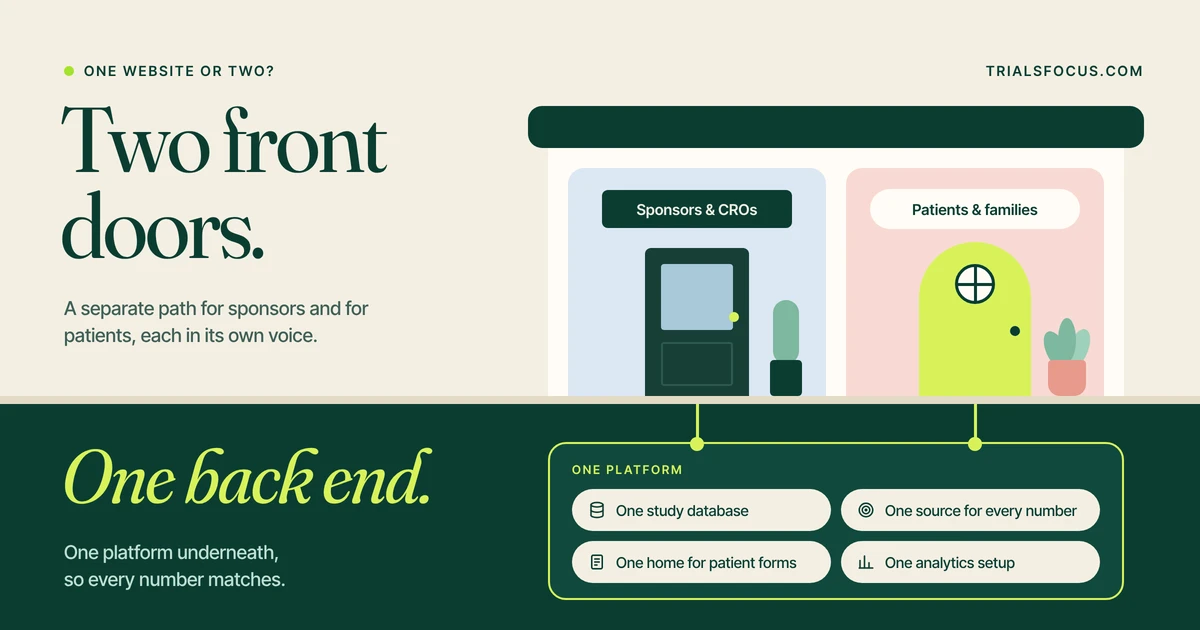
The alternative is what we call one ecosystem, two front doors: a single foundation behind two separate entry points. One platform, one study database, one source of numbers, one design system, one analytics and consent layer. On the front end, a sponsor and a patient each get their own path, navigation and tone.
The sponsor door carries what a desk review needs: capabilities, site profiles with investigators and equipment, a verifiable track record, quality systems and a short feasibility form. The patient door carries a study finder, plain-language study pages, clinic pages written from a patient’s view, and real translations.
Visitors get the same separation they would get from two websites. Behind it, there is only one version of the truth.
When we built the website for Arya Clinical, a multi-site research network in the Midwest, we placed Partner With Us and Enroll in a Study side by side on one domain, so each reader finds their door from the first screen.
When does a second domain make sense?
A second domain makes sense when you want a warmer patient brand than your corporate name, and you plan to run steady paid campaigns for patients. In that case a separate patient domain can help: the tone can be softer, ad tracking stays away from the sponsor side, and every page has a single purpose.
For the sponsor side the difference is small. Sponsors search for your organization’s name, and they expect to find it at your main domain.
Also weigh what your current domain has already earned. If it has years of history and a library of articles, a new patient domain starts from zero in search, and you will need to support it with ads for the first months.
The rule I give owners is simple: a second front end is fine, as long as it does not bring a second back end with it.
The six conditions for a two-domain setup
If budget is not the constraint and a separate patient domain fits your strategy, hold it to these six conditions:
- One back end and one study database. A study is entered once and appears on both websites.
- Deep links in both directions. Study pages link to the matching therapeutic area and site profile, and back again.
- One source for every number. Each figure has a definition, a date and an owner, and both websites read from it.
- The same design system and a visible brand link. A patient and a sponsor should both recognize the same organization.
- Measurement across domains and one consent layer. One funnel, one set of reports, one cookie and consent setup.
- The same privacy policy and HIPAA-aware forms. Prescreen forms use a provider that signs a BAA, and form pages carry no ad pixels.
If a setup cannot meet all six, it is usually better as one domain with two doors.
A 10-point check for your current setup
Whether you run one website or two today, these checks show whether your two audiences are being served or quietly split apart. Several of them map to items in the Trialsfocus Benchmark.
- Within five seconds of landing, a sponsor and a patient can each see which path is theirs.
- Your site count, years in operation and studies completed are identical on every page and every domain.
- Each number has a written definition, for example whether “studies completed” includes studies without an NCT number.
- Every active study has its own page and URL, not one template page with a parameter.
- Study pages link to the site where the study runs, and site pages link to their open studies.
- A sponsor can reach a named business development contact with a short feasibility form.
- Patient prescreen forms ask eligibility questions before personal details.
- Translated pages are human translations on their own URLs, set up with hreflang, not a translate widget.
- One analytics setup follows a patient lead from first click to prescreen, and one follows a sponsor from capabilities page to feasibility request.
- Recruitment wording follows FDA guidance on recruiting study subjects: payment is mentioned, but not as the headline, and investigational products are not promised as better treatment.
Common mistakes
Splitting the audience by splitting the team. One person updates the corporate website, another updates the patient website, and nobody owns the numbers. Give the numbers one owner first.
Leaving patient content on the sponsor side. Old patient articles and patient forms often stay on the corporate website after a patient website launches. Google keeps sending patients there, and they land on a feasibility page.
Writing location pages for two readers at once. A page whose search description speaks to patients and whose button asks for a feasibility call serves neither. Pick the reader per page, then link to the other door.
Publishing numbers before they are final. Sponsors read every footnote. A metric marked “to be verified” reads as a metric that is not true yet.
Treating accessibility as a plugin. An overlay does not make a website accessible. Build to WCAG 2.2 AA in the templates themselves.
FAQ
Should a clinical research site have separate websites for sponsors and patients?
It should have separate experiences, not necessarily separate websites. One platform with a sponsor path and a patient path gives both readers what they need while keeping one study database and one set of numbers.
Is a separate patient recruitment website better for SEO?
Not by default. A new domain starts without search history, while your main domain may already rank for your name, your locations and your articles. A separate patient domain usually needs paid support in its first months.
Do sponsors look at a site’s website during feasibility?
In our experience many do, often before the first call. They are checking that your capabilities, locations and track record are consistent and verifiable, so mismatched numbers cost more than plain design.
We walk through what they check in What a CRO Site Selector Sees in the First 60 Seconds.
How should multilingual patient pages be built?
As human translations on their own URLs, linked with hreflang, and reviewed by your IRB like the English recruitment text. A translate widget is not indexed and often mistranslates clinical terms.
What does HIPAA-aware mean for a prescreen form?
It means health information goes to a form provider that will sign a Business Associate Agreement, is not sent by plain email, and form pages carry no advertising pixels. Your legal counsel confirms the details for your organization.
Takeaways
The question is rarely one domain or two. It is whether your sponsor side and your patient side tell the same truth.
Keep the doors separate and the foundation shared. If you already run two websites, start with the six conditions above, beginning with one owner for every number.
If you would like a second pair of eyes on how your current setup serves both readers, I am happy to take a look.
About the author. Ali Demirci is the founder of Trialsfocus, a boutique agency that designs and builds websites for US clinical research sites, with every page reviewed through a sponsor lens and a patient lens. He has built WordPress websites since 2011. alidemirci.com · LinkedIn
Sources

Ali Demirci
Ali Demirci has been designing and building websites since 2011, with work ranging from a London charity to Panasonic, and now focused almost entirely on clinical research. Trialsfocus was built around a single observation: a research site's website is read by a patient deciding whether to trust you and a sponsor deciding whether to shortlist you, and most sites are written for neither. He also publishes the Trialsfocus Benchmark, a 70 point public standard for research site websites.